Nearly 840,000 blind spot accidents happen every year in the United States. About 300 of them are fatal, and commercial trucks are involved far more often than passenger vehicles because of their large blind zones, according to the National Highway Traffic Safety Administration.
Those numbers are not just statistics on a page. They point to a serious liability problem that too often goes unnoticed until something goes wrong.
The Blind Spot Problem Is Worse Than Most Fleet Managers Realize
Large commercial vehicles present visibility challenges that standard mirrors were never designed to solve. The FMCSA Large Truck Crash Causation Study found that 14% of all large truck crashes occurred due to commercial motor vehicle drivers’ inadequate surveillance. The four primary blind spots on commercial trucks, what safety experts call “no zones,” can extend up to 20 feet in front of the cab and 30 feet behind the trailer.
Think about that geometry for a moment. A pedestrian, cyclist, or compact car can be completely invisible to a driver who’s checking mirrors correctly and following every protocol.
The Insurance Institute for Highway Safety studied this problem extensively and reached a striking conclusion: blind spot detection is the most promising technology for preventing large truck crashes of any severity. Their 2012 research by Jermakian found that among the 97,000 annual large truck crashes involving intentional lane changes, blind spot detection could prevent or mitigate nearly 39,000 of them.
Why Mirrors Aren’t Enough Anymore
The trucking industry has relied on convex mirrors and proper adjustment techniques for decades. These approaches helped, but they were designed for a different era.
Today’s operating environment presents challenges that mirrors cannot address. Urban delivery routes with cyclists weaving through traffic. Distribution centers are crowded with workers on foot. Construction zones where lane positions shift unpredictably. In these conditions, the fragmented views from multiple mirrors create cognitive load at exactly the moments when drivers need clarity most.
IIHS fatality data underscores the human cost of these limitations: 17% of all deaths in large truck crashes in 2023 were pedestrians, bicyclists, or motorcyclists. These vulnerable road users often enter blind zones without any warning reaching the driver.
The physics of large vehicles make this problem inherent to the design. No amount of driver training eliminates blind spots, it only teaches drivers to work around them more carefully. And even the most experienced drivers face moments of distraction, fatigue, or unexpected situations where careful workarounds fail.
See how SalSon Logistics turned a $9 million insurance problem into a strategic advantage
Accident payouts dropped from six‑figure annual totals to under $200,000 by 2024.
Better yet, drivers are protected, insurers are competing for their business, and a stronger safety culture now fuels their profitability.
The Technology Shift: From Fragmented Views to Complete Awareness
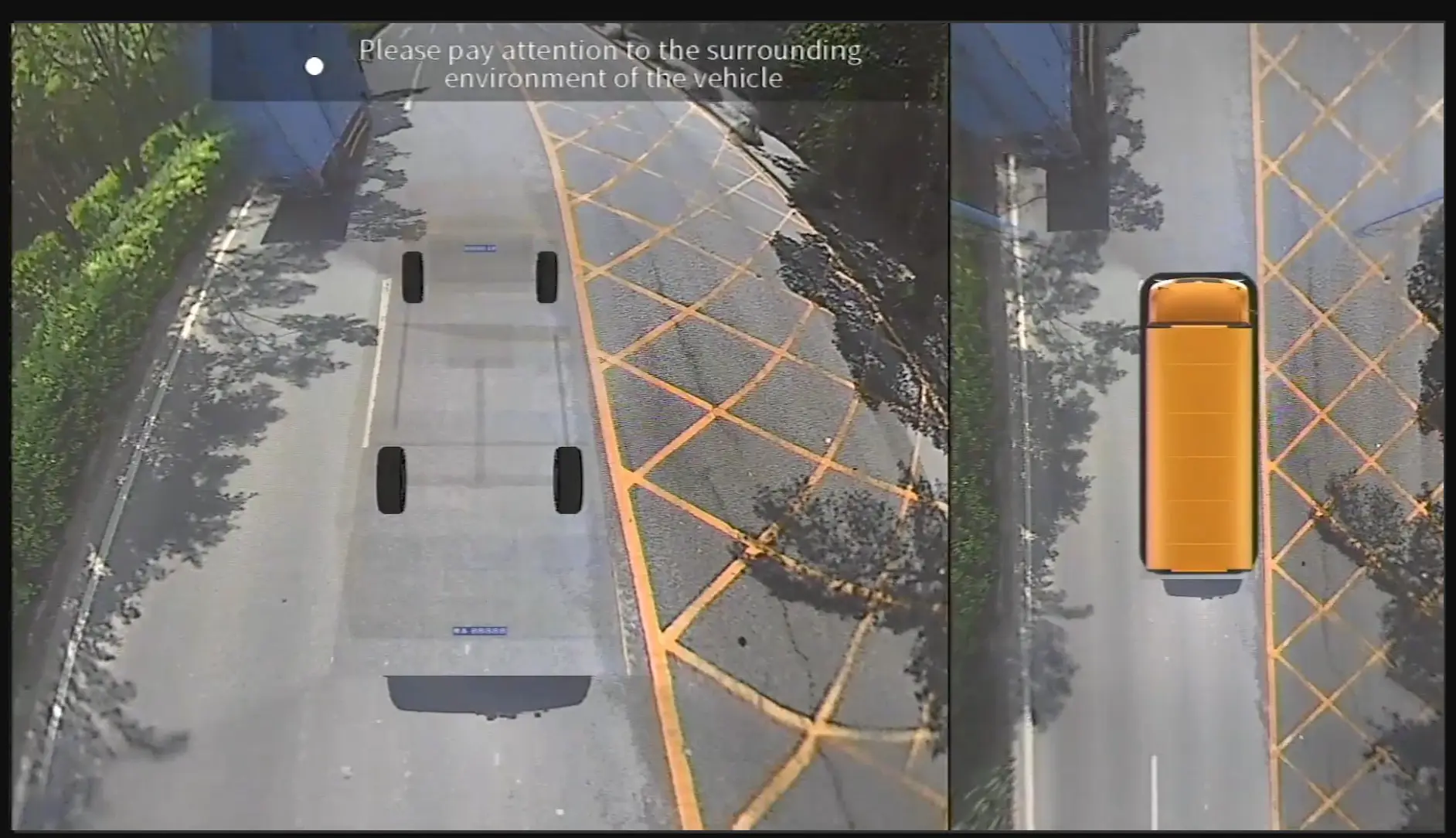
The solution emerging across safety-focused fleets transforms how drivers perceive their surroundings entirely. Rather than checking multiple mirrors and mentally assembling a picture of what’s around the vehicle, 360-degree camera systems synthesize feeds from strategically positioned cameras into a single, intuitive bird’s-eye view.
This isn’t an incremental improvement. It’s a fundamental change in situational awareness.
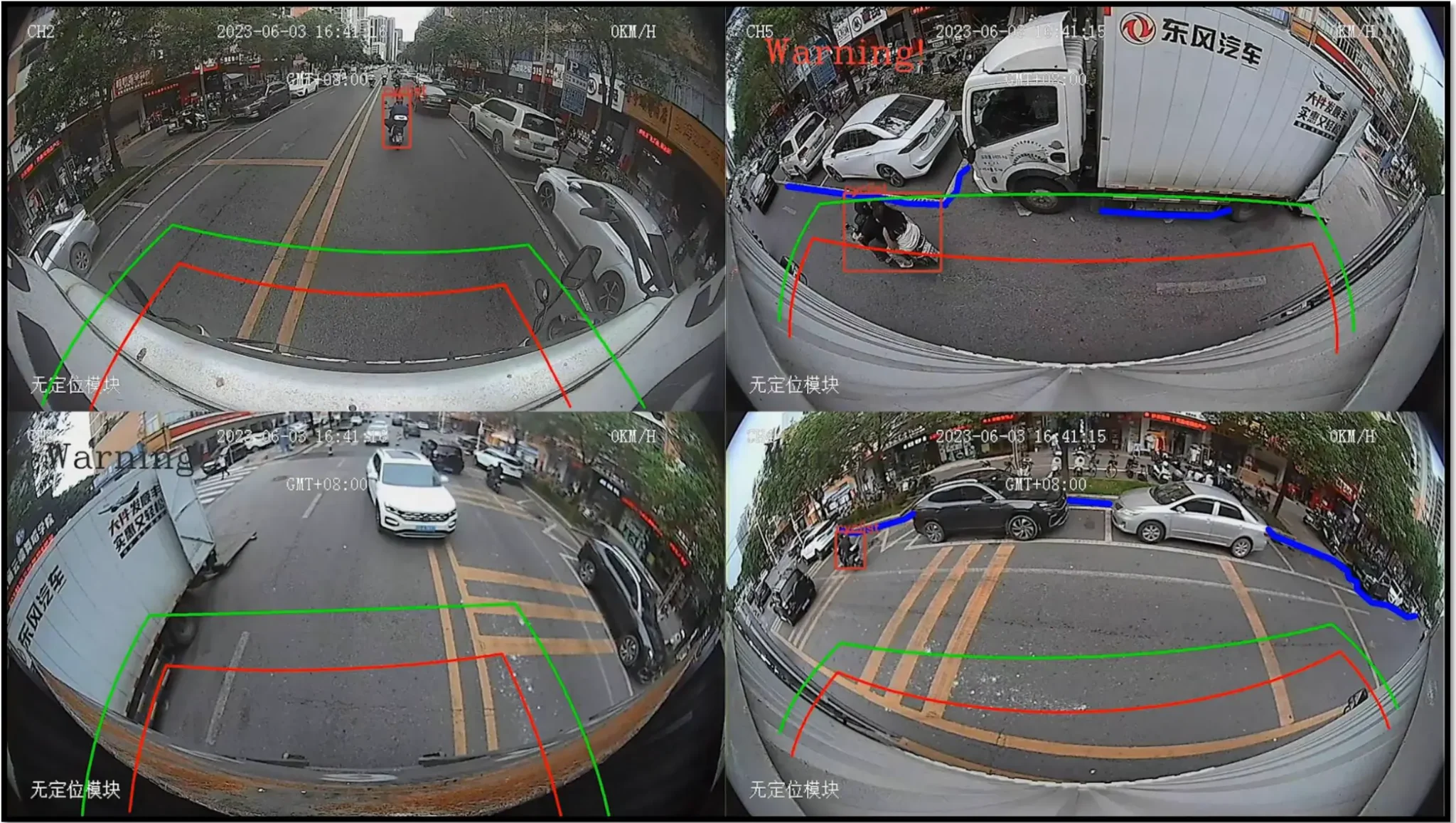
When four fisheye cameras feed into AI-powered image stitching, the result is real-time visibility around the entire vehicle perimeter. Blind spots don’t shrink, they disappear. Drivers see what’s actually there rather than inferring it from partial information.
The research supports this approach. IIHS studies found that blind spot detection reduces lane-change crashes by 14% and injury crashes by 23%. The Jermakian study concluded that combining multiple crash avoidance features, including blind spot monitoring, could prevent or mitigate 28% of all crashes involving large trucks.
Beyond Detection: Vulnerable Road User Protection
Modern 360-degree systems go beyond passive visibility. Continuous vulnerable road user detection actively tracks pedestrians, cyclists, and motorcyclists around the entire vehicle perimeter. When anyone enters the detection zone, drivers receive visual alerts providing critical reaction time.
Sophisticated systems now distinguish between vulnerable road users on active roadways versus those safely positioned on shoulders. This intelligence reduces alert fatigue while maintaining vigilance for genuine hazards, which is a balance that determines whether drivers trust the technology or learn to ignore it.
Lane departure warnings add another protective layer. A 2015 study of lane-departure warning systems in heavy-duty U.S. trucks found that crash rates were cut almost in half when the system was present. When combined with blind spot monitoring, these functions create overlapping safety coverage that catches risks individual systems might miss.
The Financial Case for Comprehensive Blind Spot Elimination
Fleet managers making the case for 360-degree camera systems often find the ROI conversation easier than expected.
Insurance represents the most direct impact. Many commercial insurers now offer premium reductions for video-based safety systems. With nuclear verdicts against trucking companies frequently exceeding $10 million and average verdicts reaching $27.5 million, insurers increasingly view cameras as essential risk mitigation rather than optional equipment.
Claims costs tell an even more compelling story. Industry data indicates camera systems reduce claims costs by 60-80% through faster dispute resolution and fraud prevention. When incidents occur, comprehensive video documentation typically accelerates resolution and protects against fraudulent claims, which the Coalition Against Insurance Fraud estimates cost over $308 billion annually across all sectors.
The SalSon Logistics case illustrates these dynamics in practice. After implementing AI-powered camera systems, their insurance payouts dropped from over $9 million in 2017 to less than $200,000 in 2019. Accidents fell from 418 to just 24. Their Vice President summarized the transformation simply: “We’re not flying blind anymore.”
Driver Acceptance: The Often-Overlooked Success Factor
Technology only delivers results when drivers use it effectively. Many fleet managers worry about resistance to camera systems, but the data suggests acceptance follows understanding.
When drivers recognize that cameras protect their careers from false accusations, the conversation shifts. In an era of staged accident fraud and aggressive litigation, documentation becomes a shield rather than surveillance. Camera-equipped vehicles often become preferred assignments as drivers see colleagues exonerated by footage that would otherwise have been their word against a fraudulent claim.
The protective benefits extend to operational efficiency. The 360-degree view enhances maneuvering in tight spaces, such as loading docks, distribution centers, and congested urban environments, where visibility limitations have traditionally slowed operations and created stress.
TRUSTED BY INDUSTRY LEADERS


 Mike Stahnten
Trustindex verifies that the original source of the review is Google.
I have been a customer of Vestige for over 5 years. Megan and Corey do an awesome job and get us whatever we requested extremely quickly whether it’s an emergency that we need video of or a simple report we want! Their system has saved us from several Faldo claims and the software has never let us down! Jake CrainVery effective and reliable resource in the field. Product is durable and does everything you’ll need from A-Z, remember you get what you pay for so why not get the best you can. Thank you Vestige for your support and business in this demanding field!
 Drake SawmillOne of our trucks lost a drive line and no parts houses had one in stock. We were able to find it by watching the video from the side camera to see where it landed. Excellent product, and customer service at Vestige is excellent! Much better than other dash cam companies we have used in the past. Highly recommend.
 Dan De La TorreGreat products and Service... we were hesitant about getting the Dashcam Service but within a few months it basically paid for itself due to an accident we had that could have been considered our fault but thanks to the camera I was actually able to share it with the Trooper that worked the accident. Not sure how many different set ups they offer but we are very happy with the basicly Live DashCam service we got that also has GPS integrated . Its great having it all in one App.
Implementation Considerations
Deploying 360-degree camera systems across a fleet requires attention to several practical factors.
Environmental durability matters for commercial applications. Systems rated for operating ranges from -40°C to +70°C handle the temperature extremes trucks encounter. Storage capacity determines how long footage remains available, which is a critical consideration, as risk advisors recommend retaining footage for several years, given that complaints can evolve into litigation.
Integration capabilities determine whether camera systems work alongside existing fleet management platforms or create data silos. Systems supporting standard J1939 protocol and common interfaces (RS232, RS485, CAN bus) typically integrate more smoothly with the telematics infrastructure already in place.
Calibration complexity affects deployment speed. Systems requiring extensive manual adjustment, slow rollouts, and create ongoing maintenance burden. AI-powered automatic calibration, some systems complete setup in under 15 seconds, faster fleet-wide implementation without specialized expertise at each location.
The Regulatory Trajectory
While dash cameras aren’t federally mandated, both FMCSA and NTSB have consistently recommended onboard cameras to enhance safety oversight and crash investigation capabilities. The regulatory direction is clear, even if specific requirements haven’t materialized.
Proactive fleets are implementing comprehensive camera systems not to meet minimums but to establish defensible safety programs. When incidents occur, and in trucking, incidents eventually occur, a documented commitment to best-practice safety technology shapes how regulators, insurers, and juries perceive the fleet’s overall approach to risk management.
Moving Beyond Acceptable Risk
Every fleet operates with some level of blind spot risk built into daily operations. The question isn’t whether blind spots exist; the physics of large vehicles guarantee they do. The question is whether that risk remains acceptable given available technology.
With staged accident fraud increasing and the liability landscape shifting toward outcomes that can threaten fleet viability, the calculus has changed. Blind spot elimination isn’t a future capability. It’s available now, proven in deployment, and delivering measurable returns for fleets willing to move beyond traditional approaches.
The 840,000 annual blind spot accidents represent preventable harm. For fleet operators weighing the investment, the real question may be simpler than ROI calculations suggest: knowing what’s possible, what’s the cost of choosing not to see?
Vestige’s 360° Camera System provides complete blind spot elimination through four fisheye cameras and AI-powered image stitching, delivering real-time bird’s-eye visibility around the entire vehicle. Request a demonstration to see how comprehensive camera coverage can transform your fleet’s safety program.
Sources
Statistic | Source |
840,000 blind spot accidents annually, 300 deaths | NHTSA — widely cited across industry sources |
14% of large truck crashes are due to inadequate surveillance | |
Blind spots extend 20 ft front, 30 ft rear | |
39,000 preventable lane-change crashes | |
17% of large truck crash deaths were VRUs (2023) | |
BSD reduces lane-change crashes 14%, injuries 23% | |
Combined technologies prevent 28% of truck crashes | |
LDW cut truck crash rates nearly in half | |
Nuclear verdicts exceed $10M, avg. $27.5M | |
Camera systems reduce claims by 60-80% | |
Insurance fraud costs $308B annually | |
SalSon: $9M → $200K payouts, 418 → 24 accidents |
Trusted Safety Partners