
Protect Your Remote and Isolated Workforce With Lone Worker Safety Devices
Let us help you protect your people!
Discreet Wearable Design:
Compact, lightweight button that's easy to carry or wear—ideal for lone workers, educators, and healthcare staff.
Silent Emergency Alerts:
Send instant, silent distress signals with precise GPS location—no need to reach for a phone.
Real-Time GPS Tracking:
Live tracking for fast response and full visibility of employees in the field or in remote settings.
Seamless Platform Integration:
Automatically logs location, clock-in/out times, and emergency activity—all in one easy-to-use dashboard.
Regulatory Compliance:
Helps meet safety mandates like OSHA and Alyssa’s Law while reducing liability risks.

Henry Ford Health Chooses Vestige's Persa To Protect Remote Workers In Michigan
Simplicity, reliability and alert customization drive decision to deploy and retain Vestige PERSA safety solution
Every year, workplace violence leads to more than 2 million American workers reporting incidents, and employees working alone face significantly higher risks. When your team members work in isolation, whether in healthcare facilities, on construction sites, during home inspections, or in field service roles, they encounter unique dangers with no immediate help available. This makes lone worker safety technology not just a compliance issue, but a critical business necessity.
Organizations across industries are realizing that protecting isolated employees takes more than traditional safety protocols. Today’s lone worker safety devices combine real-time monitoring, instant emergency response, and detailed documentation to keep vulnerable employees safe while meeting regulatory requirements.
Understanding Lone Worker Safety Challenges
Lone workers face hazards that differ fundamentally from employees in team environments. Lone worker safety devices help bridge that gap by providing real-time alerts and monitoring capabilities. Without direct supervision or immediate assistance, they are especially vulnerable to emergencies that require specialized safety solutions.
Medical emergencies, such as heart attacks, strokes, slip-and-fall injuries, or other medical crises, are particularly dangerous for lone workers. Field technicians, home healthcare workers, and maintenance personnel can face life-threatening situations if there’s no way to quickly alert supervisors or emergency services.
Workplace violence is another growing concern. Healthcare workers making home visits, utility workers entering customer properties, tow truck operators responding to roadside calls, and retail staff working overnight shifts all face potential confrontations. According to research from the International Association for Healthcare Security and Safety, body cameras helped settle workplace disputes 78% of the time in healthcare settings, demonstrating the value of visible safety technology.
Environmental hazards also pose serious risks. Construction inspectors, utility workers in confined spaces, agricultural operators, and environmental technicians can encounter accidents that go unnoticed without proper monitoring.
Transportation risks add yet another layer of risk. Field sales representatives, delivery drivers, home healthcare workers, and service technicians spend significant time on the road, facing accident risks and potential vehicle breakdowns in isolated areas. These workers often face accidents or breakdowns, often in isolated areas where cellular coverage may be limited.
Ultimately, the isolation inherent in lone work is the core challenge: when something goes wrong, no one is there to help. This reality has driven regulatory agencies to require lone worker safety devices and motivated organizations to adopt robust safety technology solutions.
OSHA and Regulatory Requirements for Lone Worker Safety
Understanding your compliance obligations forms the foundation of any effective lone worker safety program. Multiple regulatory frameworks set specific requirements for protecting isolated employees who work in isolation across different industries.
OSHA General Duty Clause requires all employers to provide a workplace “free from recognized hazards that are causing or are likely to cause death or serious physical harm.” This mandate applies directly to lone worker situations, where employers must take reasonable steps to protect employees working in isolation. OSHA has cited companies that failed to implement adequate safety measures for lone workers, particularly after serious incidents.
Industry-specific regulations create additional requirements for certain sectors. Healthcare facilities must comply with workplace violence prevention standards that increasingly mandate panic button technology for staff working in psychiatric units, emergency departments, and home health settings. Several states have passed legislation requiring healthcare facilities to provide panic buttons for healthcare workers as standard safety equipment.
The construction industry also has unique obligations under OSHA standards. Workers entering confined spaces, performing work at heights, or operating heavy equipment must have reliable communication and emergency response systems. Compliance officers regularly verify whether lone workers have appropriate safety technology during worksite inspections.
Transportation regulations under FMCSA cover drivers working alone on long-haul routes. While dash cameras and vehicle tracking are often used for fleet management, they also play a critical safety role. These systems must meet mounting requirements and not obstruct driver visibility, as specified in federal regulations.
State-level requirements often exceed federal minimums. Some states require specific response times for emergencies involving lone workers. Others mandate particular types of safety equipment or check-in procedures. California, New York, Illinois, and Washington have been particularly active in establishing strong lone worker protection requirements.
Finally, thorough documentation is essential. Organizations should maintain records of safety equipment provided, training, incident response procedures, and actual emergencies. Proper documentation protects companies during OSHA inspections and potential litigation while helping identify areas for safety program improvement.
Core Features of Modern Lone Worker Safety Technology
Understanding the core features of these technologies helps organizations select lone worker safety devices and systems that truly protect their isolated employees.
Panic button functionality forms the foundation of lone worker safety technology, allowing employees to signal distress instantly with a single press. Modern wearable panic buttons come in various forms, including badges, watches, key fobs, and smartphone apps. The key factor is that activation must be simple, discreet, and reliable even under extreme stress.
The best panic button systems offer multiple activation methods. Some situations allow workers to press a button openly, while others require covert activation where the worker cannot safely reach for a device. Advanced features like tilt detection can automatically trigger alerts if a worker falls and remains motionless, and automated check-ins send alerts if scheduled responses aren’t received.
GPS location tracking transforms panic buttons into complete safety solutions. Knowing the worker’s exact location enables rapid response, while real-time GPS tracking shows supervisors where employees are throughout their shifts, allowing for better coordination and faster emergency response. For workers who travel between multiple locations daily, this feature proves invaluable.
Geofencing capabilities allow organizations to create virtual boundaries and receive alerts when workers enter or leave designated areas. This proves particularly valuable for workers in high-risk locations or those who work in areas with known security concerns. Historical tracking data also helps organizations review worker routes and identify potential safety improvements.
Two-way communication allows workers to explain their situations and receive guidance during emergencies. Unlike basic panic buttons that only send alerts, comprehensive systems include voice communication capabilities. This allows emergency responders to assess situations accurately and provide guidance while help is on the way. Workers can describe their location, explain the nature of the emergency, and receive reassurance that help is coming.
Automated alerts and escalation protocols ensure appropriate personnel receive notifications immediately when emergencies occur. Basic systems might only alert a single supervisor, while advanced platforms can simultaneously notify multiple people, trigger automated calls to emergency services, and escalate to higher-level management if initial responders don’t acknowledge alerts within specified timeframes.
Man-down detection and fall alerts use accelerometers and motion sensors to automatically trigger alerts when workers fall or remain motionless for extended periods. This proves critical for workers who might be injured, experience medical emergencies, or face situations where they cannot manually activate panic buttons. These systems typically include configurable sensitivity settings to reduce false alarms while maintaining reliable detection.
Battery life and reliability separate consumer-grade devices from professional lone worker safety technology. Workers need devices that function reliably throughout entire shifts without requiring frequent recharging. The best systems include battery status monitoring that alerts supervisors before devices run low, ensuring workers never start shifts with inadequate battery life.
Check-in and monitoring features provide ongoing verification of worker safety. Automated prompts confirm employees are okay, and any missed responses are escalated to supervisors for investigation. Together, these features create a complete protection system tailored to the risks and environments your workers face, making lone worker safety devices an essential part of modern safety programs.
Henry Ford Health trusts PERSA for mobile clinicians
The Michigan Health System turns to Vestige and its 24-hour call center to provide simple and affordable panic button technology to protect staff working in challenging environments.
TRUSTED BY INDUSTRY LEADERS




Body-Worn Cameras as Lone Worker Protection
Body-worn cameras have emerged as powerful tools for lone worker safety, providing capabilities that extend far beyond simple video recording. These devices offer protection before, during, and after incidents while serving multiple organizational objectives.
The presence of visible body-worn cameras provides significant de-escalation benefits. Research consistently shows that individuals behave more appropriately when they know interactions are being recorded. For home inspectors, field service technicians, healthcare workers, and other lone workers who enter customer properties, visible cameras often prevent confrontations before they escalate.
Industry data from home inspection professionals is particularly revealing. According to the American Society of Home Inspectors, 80% of accusations against home inspectors are exaggerated or meritless. Body cameras provide objective documentation that protects workers from false claims while encouraging professional interactions from all parties.
Real-world protection cases demonstrate the practical value of body-worn cameras. One home inspector’s camera captured a homeowner ripping down blinds and falsely accusing him of the damage, immediately exonerating the inspector. Another inspector proved a roof tile was already broken before the inspection began, dismissing what could have been a costly damage claim. Multiple inspectors have used footage to prove they didn’t steal client valuables after being falsely accused.
The documentation capabilities of body cameras go beyond confrontations. Workers can record arrival conditions, capture before-and-after documentation of work performed, and create visual records of site hazards. This footage becomes valuable for training, quality assurance, and defending against liability claims. Service businesses report that customers rarely claim work wasn’t performed after learning interactions are recorded.
Legal and compliance considerations require careful implementation of body camera programs. Some states require consent before recording, particularly for audio capture or in private spaces. Organizations must establish clear policies about when cameras should be recording, how footage is stored, who can access recordings, and retention periods. Privacy laws in states like Illinois, Texas, and Washington have specific requirements for biometric data and audio recording that organizations must follow.
Integration with panic button systems creates even more powerful safety solutions. When workers trigger panic buttons, body cameras can automatically begin recording and streaming live video to supervisors. This allows emergency responders to assess situations in real-time and provide appropriate assistance. Some advanced systems even allow supervisors to activate cameras remotely if they suspect workers are in danger.
Storage and retention requirements vary by industry and jurisdiction. Some organizations retain body camera footage for days or weeks, while others keep recordings for up to five years to cover legal statutes of limitation. Cloud-based storage solutions provide scalable, secure options for managing large volumes of video data while ensuring footage remains accessible for investigations and legal proceedings.
Industry-Specific Applications
Different industries face unique lone worker challenges, requiring tailored safety technology. Understanding how sectors implement these solutions helps organizations select strategies that match their specific risks.
Healthcare and Home Health Services
Healthcare workers face some of the highest workplace violence rates of any industry. Home health nurses, hospice workers, social workers, and behavioral health professionals regularly work alone in patient homes and communities. These workers need healthcare safety solutions that provide instant emergency response without requiring obvious actions that might escalate aggressive patients.
Discreet wearable panic buttons, designed as badges or watches, allow workers to signal distress without escalating situations. GPS tracking enables rapid response, and many organizations now mandate panic button use, especially for behavioral health and hospice staff. The PERSA standard provides reliable emergency alert capabilities that extend beyond facility walls.
Field Service and Utilities
Utility workers, HVAC technicians, cable installers, and other field service professionals frequently work alone in customer homes and remote locations. These workers face risks from aggressive customers, hazardous work environments, and accidents in isolated areas.
GPS tracking combined with automated check-ins ensures supervisors know worker locations and status, while geofencing adds extra monitoring in high-risk zones. Automated alerts can signal prolonged inactivity, indicating potential injuries or equipment problems.
Construction and Inspection
Building inspectors, HVAC contractors, electricians, and other construction professionals often work alone in partially completed structures, vacant properties, and active construction sites. These environments present multiple hazards, including falls, electrical dangers, structural collapses, and encounters with unauthorized individuals in vacant properties.
Combining panic buttons with man-down detection provides critical protection for these workers. If an inspector falls through damaged flooring or an electrician is incapacitated by electrical shock, automatic fall detection triggers an emergency response even if the worker cannot press a button. Tool and equipment tracking systems also provide location awareness that aids emergency response.
Delivery and Transportation
Delivery drivers, long-haul truckers, and courier services represent another significant lone worker category. These employees work from vehicles, often in unfamiliar areas and during high-crime hours. While fleet GPS tracking serves primarily for route optimization and vehicle management, it provides essential safety monitoring for isolated drivers.
Advanced fleet systems integrate panic buttons accessible from vehicle cabs, automatic crash detection, and harsh event monitoring that can indicate accidents or dangerous driving conditions. Two-way communication enables drivers to request assistance or report dangerous situations without leaving their vehicles.
Security and Law Enforcement
Security guards, parking enforcement officers, and private investigators frequently work alone in high-risk situations. These professionals need robust safety technology that functions reliably during confrontations. Body-worn cameras serve dual purposes—providing evidence collection capabilities while offering protection through visible recording. Many security firms implement layered safety protocols combining panic buttons, GPS tracking, automated check-ins, and body cameras.
Below are the alert levels you can forward:
Red Alert
An employee can send distress signals to request immediate assistance for a 911 call.
Yellow Alert
Users can report concerning situations to their team through text or email.
Regular check-in (Green code)
The system requires regular check-ins from professionals on duty.
Implementation Best Practices
Successfully deploying lone worker safety devices and technology requires more than simply purchasing equipment and distributing it to employees. Organizations that achieve the best results follow structured implementation processes that ensure technology is properly configured, employees are adequately trained, and systems integrate smoothly with existing operations.
A comprehensive risk assessment should precede any technology selection. Organizations must identify specific threats their lone workers face, evaluate the likelihood and potential severity of different scenarios, and understand the work environments where employees operate. This assessment helps match technology features to actual needs rather than purchasing generic solutions that might miss critical requirements.
Consider factors like cellular coverage in work areas, typical duration of worker isolation, nature of threats workers face, physical demands of jobs that might affect what workers can comfortably wear or carry, and regulatory requirements specific to your industry and locations. This analysis provides the foundation for informed technology selection.
Employee involvement dramatically improves adoption rates and program effectiveness. Workers who help select safety technology are more likely to use it consistently and provide valuable feedback for ongoing improvements. Organize focus groups with employees who will use the technology, conduct pilot programs with small groups before full deployment, gather feedback on comfort, ease of use, and functionality, and incorporate worker suggestions into the final system configuration.
Some workers initially resist safety monitoring technology, particularly if they perceive it as excessive surveillance rather than protection. Transparent communication about how systems work, what data is collected, who can access information, and how technology protects rather than monitors workers helps overcome resistance.
Thorough training programs ensure workers understand how to use safety technology effectively. Training should cover not just button locations and activation procedures, but also when to use different features, how to perform regular equipment checks, proper charging and maintenance procedures, understanding system capabilities and limitations, and practicing emergency scenarios.
Training must extend beyond workers to include supervisors, dispatchers, and management personnel who will receive and respond to alerts. These individuals need to understand proper response protocols, how to access location and communication features, escalation procedures when situations worsen, and documentation requirements for incident records.
Clear policies and procedures establish expectations and ensure consistent responses to emergencies. Written policies should address equipment assignment and maintenance responsibilities, when workers must have devices activated, check-in schedules and procedures, emergency response protocols with specific timeframes, escalation procedures when initial responses are inadequate, and testing schedules to verify system functionality.
Integration with existing systems maximizes technology value while simplifying operations. Lone worker safety systems should connect with dispatch and scheduling software to automatically track worker locations and assignments, time and attendance systems to verify workers have safety equipment before clocking in, incident management platforms for thorough documentation, and emergency notification systems for rapid response team deployment.
Regular testing and maintenance keep systems functioning reliably when emergencies occur. Organizations should establish testing schedules that verify panic button functionality, confirm GPS accuracy, test communication capabilities, check battery life and charging equipment, and validate alert delivery to appropriate personnel.
Monthly or quarterly emergency drills help identify system weaknesses and ensure everyone understands their roles during actual emergencies. These drills should simulate realistic scenarios workers might face while testing response times and communication effectiveness.
Data analysis and continuous improvement transform safety technology from static tools into evolving programs that become more effective over time. Organizations should regularly review panic button activation patterns to identify high-risk situations, analyze GPS data to optimize worker routes and reduce isolation periods, evaluate response times and identify improvement opportunities, assess training effectiveness and update programs based on actual incident experiences, and gather ongoing worker feedback about equipment functionality and comfort.
The most successful implementations treat lone worker safety devices and supporting technology as living programs that evolve based on experience rather than one-time projects that conclude after initial deployment.
Calculating ROI and Cost Justification
Many organizations hesitate to invest in this lone worker safety technology due to perceived costs. However, detailed analysis consistently reveals that these systems deliver substantial returns on investment through multiple value streams beyond the fundamental imperative of protecting employees.
Workers’ compensation cost reduction often provides the clearest financial benefit. Workplace injuries involving lone workers typically cost 30% to 50% more than similar injuries in team environments due to delayed discovery and response. Faster emergency response enabled by panic button technology and GPS tracking reduces injury severity and associated medical costs.
Organizations that implement these safety programs typically see 20% to 40% reductions in workers’ compensation costs for covered employees within the first two years. For companies with 50 or more lone workers, this alone often justifies the technology investment.
Insurance premium reductions provide another tangible financial benefit. Some commercial insurance carriers now require or strongly encourage panic button technology for high-risk worker categories. Organizations that voluntarily implement safety programs often negotiate premium reductions of 5% to 15% by demonstrating commitment to risk mitigation.
Liability protection delivers value that’s harder to quantify but potentially more significant than direct cost savings. According to research from the American Trucking Research Institute, nuclear verdicts in workplace litigation often exceed ten million dollars. Documentation from body cameras and GPS tracking systems provides powerful evidence that defends organizations against false claims and demonstrates that reasonable safety measures were in place.
Case studies demonstrate this protection in action. Organizations have avoided hundred-thousand-dollar settlements using body camera footage showing workers were not at fault in incidents. Others have disproven false accusations of theft, property damage, and assault using objective video evidence.
Productivity improvements often exceed direct safety cost savings. GPS tracking helps optimize worker routes, reducing drive time by 10% to 15% in many organizations. Automated check-in systems eliminate time spent on manual status calls. Workers report feeling more confident when working alone with safety technology, reducing stress and improving job satisfaction.
Reduced turnover provides another significant financial benefit. Employees who work alone in high-risk situations appreciate employers that invest in their safety. Organizations that implement safety programs report lower turnover among lone worker populations, reducing recruiting and training costs that typically range from 50% to 200% of annual salary for skilled positions.
Compliance cost avoidance prevents expensive citations and penalties. OSHA citations for inadequate lone worker protection can range from thousands to hundreds of thousands of dollars, depending on severity. State-level violations in jurisdictions with specific lone worker requirements add additional financial exposure. Proactive safety technology implementation demonstrates compliance and typically satisfies regulatory requirements.
When calculating ROI, consider both hard and soft costs. Hard costs include equipment purchase or lease expenses, monthly service fees for GPS tracking and monitoring services, training time and materials, administrative time for program management, and equipment maintenance and replacement. Soft costs include productivity lost to injuries, supervisory time managing emergencies, legal costs defending against claims, reputation damage from safety incidents, and opportunity costs of not implementing better safety measures.
Most organizations find that safety programs pay for themselves within 12 to 24 months through reduced insurance costs and injury expenses alone. Additional benefits from productivity improvements and liability protection often double or triple the effective return on investment.
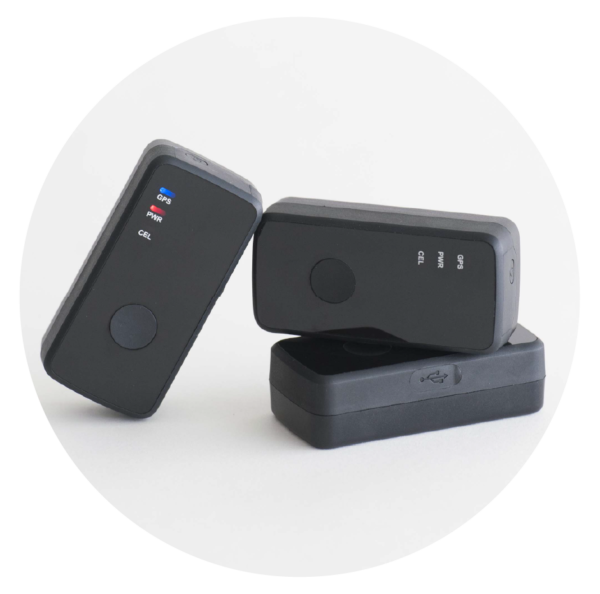
Employees are never alone with PERSA
Designed to be accessible any time you need it, PERSA is a wearable safety device and tracker complete with our software platform to ensure all remote or lone workers are safe 24/7.
- Employee clock-in and clock-out times
- Any off-site location their mobile employees may visit
- Mobile employees are on the best route to get to their site locations
Future Trends in Lone Worker Safety Technology
The lone worker safety technology landscape continues to evolve rapidly as new capabilities emerge and existing technologies become more sophisticated. Organizations planning long-term safety programs should understand the coming developments that will shape future implementations.
Artificial intelligence integration promises to make safety systems more proactive rather than purely reactive. AI algorithms can analyze worker behavior patterns and identify anomalies that might indicate emerging threats or medical issues. Systems might detect that a worker’s movement patterns have changed in ways suggesting fatigue, confusion, or physical impairment, triggering supervisor notifications before workers realize they need help.
Machine learning systems will also improve false alarm reduction. Current panic button systems sometimes trigger accidentally, creating alert fatigue among responders. AI-powered systems can learn to distinguish genuine emergencies from accidental activations by analyzing multiple data points, including activation patterns, subsequent worker responses, location data, and motion sensor readings.
Wearable technology advances will make safety devices more comfortable and functional. Current devices already include watches, badges, and key fobs, but future developments will create even less intrusive form factors. Smart clothing with integrated sensors, jewelry-style devices, and even implantable options are under development for specialized applications.
Battery technology improvements will extend device runtime while reducing size and weight. Solar charging integration and kinetic energy harvesting might eventually create devices that never require traditional charging, eliminating a current pain point in device management.
Enhanced communication capabilities will improve emergency response effectiveness. While current systems provide two-way voice communication, emerging technologies add video streaming that allows supervisors to see what workers see during emergencies. This visual information helps emergency responders better assess situations and provide more appropriate assistance.
Integration with augmented reality platforms might eventually allow remote experts to guide workers through emergency procedures by overlaying instructions on workers’ fields of view through smart glasses or helmet-mounted displays.
Improved indoor positioning will address current GPS limitations in buildings, underground locations, and dense urban environments. Technologies like ultra-wideband (UWB), Bluetooth Low Energy (BLE) beacon networks, and enhanced cellular positioning are enabling accurate indoor location tracking that rivals GPS outdoor accuracy.
Biometric monitoring integration will enable systems to detect medical emergencies before workers even realize something is wrong. Heart rate monitors, blood oxygen sensors, and other health tracking technologies can identify cardiac events, respiratory distress, and other medical conditions that might incapacitate workers. While privacy considerations require careful implementation, these capabilities could dramatically improve outcomes for workers experiencing sudden medical emergencies.
5G connectivity will enable faster data transmission, lower latency communication, and support for more sophisticated monitoring capabilities. Body camera systems might stream high-definition video continuously rather than only after panic button activation. GPS location updates could occur multiple times per second rather than every few minutes, enabling precise movement tracking.
Drone integration for emergency response represents another emerging capability. When panic buttons activate in remote locations, automated drone systems could be dispatched to provide a visual assessment while human responders travel to the scene. Drones might also deliver emergency supplies like first aid equipment or communication devices to isolated workers.
Blockchain technology for incident documentation could provide tamper-proof records of emergencies, responses, and video evidence. This would address current concerns about evidence authenticity and create indisputable documentation for legal and regulatory purposes.
These emerging technologies will not replace current safety systems but rather enhance and extend their capabilities. Organizations should select platforms that can integrate new features as they become available rather than requiring complete system replacements every few years.
Protect Your Lone Workers with Vestige Cameras
Today’s safety technology creates layered protection to prevent incidents, enable rapid response, and document interactions for accountability. From wearable panic buttons to GPS tracking, two-way communication, and body-worn cameras, solutions now fit every budget and risk level. The value extends beyond liability reduction; workers who feel protected show higher satisfaction, lower turnover, and stronger performance. Begin by assessing your unique lone worker risks and involving employees in choosing the right tools. Effective training and continuous program evaluation keep systems reliable as threats and technology evolve.
Vestige delivers complete lone worker safety solutions, combining panic buttons, GPS tracking, and body-worn cameras to protect staff across any environment. Request a quote to see how Vestige can fit your organization’s safety goals and budget.
Contact Vestige today to design a customized safety program that protects your team, meets compliance standards, and builds lasting trust.
Start Protecting Your Remote Employees Today
Are you ready to meet the security demands of modern organizations? An ESD is a cost-effective way to achieve your goals.
Many people think it’s a complicated process, but it doesn’t have to be. With Vestige on your side, you can provide guards, bouncers, and event staff with a compact, water-resistant, advanced safety device that they can comfortably wear 24/7.
There’s no other device quite like it on the market. It’s the ideal step to achieving your safety goals for personnel in your company. Request a demo now.
Frequently Asked Questions
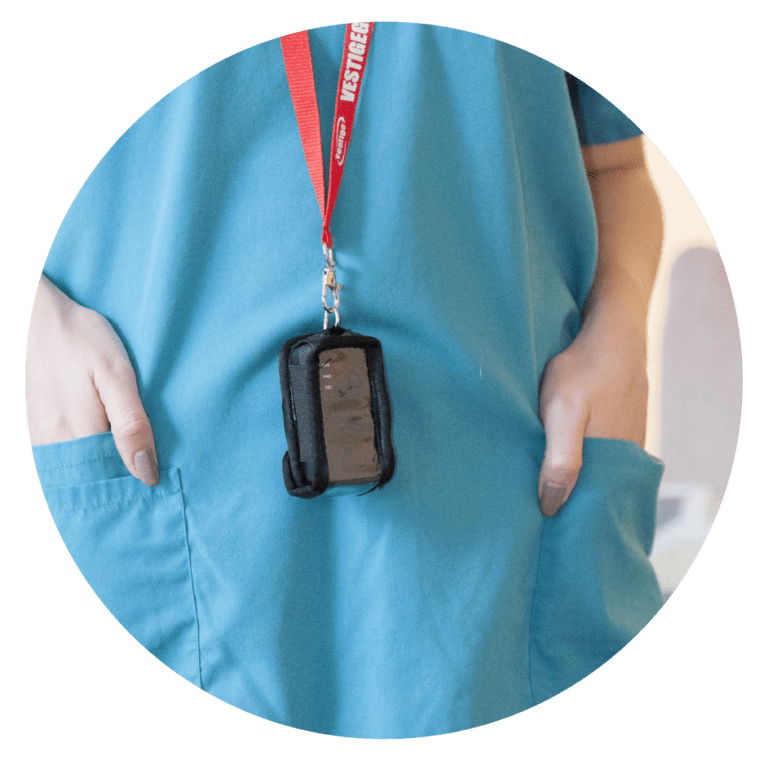
Modern panic buttons are small wearable devices that healthcare workers carry on lanyards, clips, or badges. When activated, they immediately alert security personnel or monitoring centers of an emergency while transmitting the worker’s precise location through GPS or facility-based positioning systems. Response teams can listen to the situation through the device’s microphone and coordinate appropriate intervention.
Requirements vary by industry and location. Several states now require panic buttons for healthcare workers, particularly in hospitals and home health settings. OSHA’s General Duty Clause requires employers to provide reasonably safe working conditions, which courts have interpreted as requiring appropriate safety technology for lone workers in high-risk situations. Even where not explicitly mandated, implementing panic button technology demonstrates due diligence in protecting employees.
Costs vary widely based on system sophistication and features. Basic panic button devices with GPS tracking typically range from $200 to $500 per device, with monthly service fees of $20 to $50 per user. More in-depth systems with body cameras, advanced analytics, and extensive monitoring capabilities might cost $500 to $1,500 per device with monthly fees of $50 to $150 per user. Most organizations find that these costs are offset by reduced insurance premiums and workers’ compensation expenses within the first two years.
Initial resistance is common, particularly if workers perceive devices as surveillance tools rather than safety equipment. Transparent communication about how systems work, what data is collected, and how technology protects workers typically overcomes resistance. Involving workers in device selection and encouraging feedback creates buy-in. Most importantly, workers become supporters once they understand how technology can prove their innocence in false accusation situations and provide help during genuine emergencies.
Basic implementations with simple panic button systems can be completed in two to four weeks, including device configuration, user training, and protocol establishment. Comprehensive programs involving body cameras, extensive integrations, and complex monitoring procedures might require two to three months for full deployment. Pilot programs with small user groups before full rollout help identify issues and refine procedures before company-wide implementation.
Modern lone worker safety systems include multiple location technologies beyond GPS. Wi-Fi positioning, cellular triangulation, and Bluetooth beacon networks provide indoor location capabilities. Many systems automatically switch between positioning methods based on what’s available in each location. Organizations can also deploy beacon infrastructure in facilities where workers frequently operate to ensure accurate indoor positioning.
Properly configured systems deliver alerts within seconds of panic button activation. Cloud-based platforms typically send notifications in under five seconds. The larger variable is response time—how quickly designated personnel acknowledge alerts and begin emergency response procedures. Well-designed protocols ensure multiple people receive simultaneous notifications, so a delayed response from one person doesn’t prevent others from acting quickly.